> For the complete documentation index, see [llms.txt](https://docs.keeper.io/llms.txt). Markdown versions of documentation pages are available by appending `.md` to page URLs; this page is available as [Markdown](https://docs.keeper.io/keeper-connection-manager/installation/auto-docker-install.md).
# Auto Docker Install
Automated Linux Docker installer for users without Docker experience

## Overview
Auto Docker Install is Keeper's recommended installation method.
Make sure to read the [Preparing for Installation](/keeper-connection-manager/installation/preparing-for-installation.md) section first.
The Auto Docker Install method creates a standard Keeper Connection Manager environment using a script that is easy to run. This method does not restrict any features and you can still utilize this installation with advanced control at a later time.
If you are already familiar with Docker, you may choose to use the [Docker Compose Install](/keeper-connection-manager/installation/docker-compose-install.md) method.
## Licensing
Before installing KCM, please ensure you have a valid license key. **Without a valid license key, users and administrators will be unable to use KCM after the update is applied**
For more info, visit this [page](/keeper-connection-manager/installation/license-key.md).
## Installation
**(1) Download the Installer**
From the linux command line, download the installer script using the curl command.
```bash
curl -O https://keepersecurity.com/kcm/kcm-setup.run
```
**(2) Add the execute permission to the Installer**
```bash
chmod +x kcm-setup.run
```
**(3) Run the Installer as root**
```bash
sudo ./kcm-setup.run
```
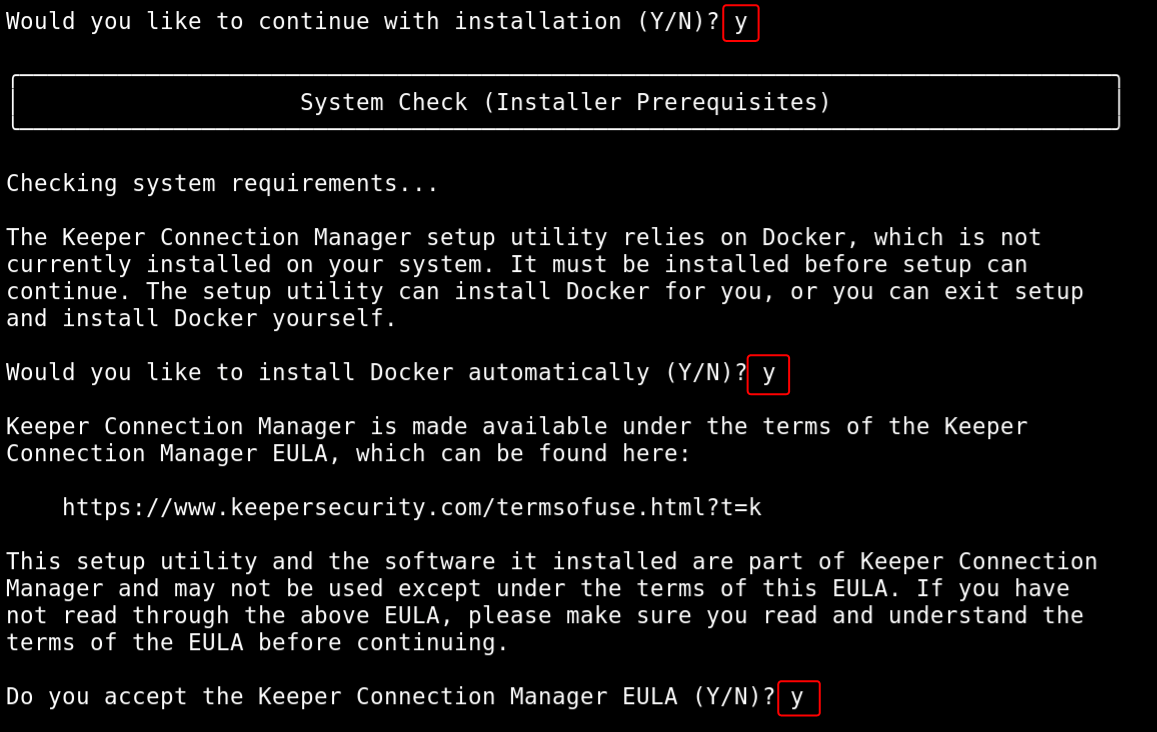
.png?alt=media\&token=91ce3ca6-40db-4af4-9b2b-ddb3f66651c0)
The next question asks if you already have SSL termination available. **If unsure, select N for no.**
At the next prompt, enter your FQDN, even if it is internal. This is where users will access KCM in their browser.
Then, choose an option for SSL. A self-signed certificate (option 3) is okay for testing. After testing is complete, make sure to put a proper SSL certificate in place.

{% hint style="info" %}
If you want to use Let's Encrypt (option 1) to quickly and easily generate and install an SSL certificate, you **must** have public DNS in place pointing to your static public IP. Also, Let's Encrypt requires HTTP port 80 and HTTPS port 443 to be open during the install process.
{% endhint %}
#### Secrets Manager Integration (optional)
The next prompt will be to choose your database, and then it will prompt for "Your one-time access token or base64 configuration". This value is [generated from Keeper Secrets Manager ](/keeper-connection-manager/vault-integration/installation.md)(a tab in your vault). If this doesn't apply to you, just press enter. You can always add it later, too.
#### Set up SSO Login (optional)
Next up is SAML. You can choose "no" to skip it (you can come back and set it up later), or you can choose "yes" to set up SSO now. [Follow the SSO setup steps here](/keeper-connection-manager/authentication/authenticating-users-with-saml.md).
### Save the credentials and URL in your Vault
After installation is completed, an admin login and password is created for you. Make sure to store this in your Keeper vault, as it's not provided again later.
```
Installation has completed successfully! You may now access your Keeper
Connection Manager installation at:
https://connection.mycompany.com/
The administrator credentials are:
Username: guacadmin
Password: **************************
Thank you for installing Keeper Connection Manager!
```
{% hint style="success" %}
Store the provided username, password, and URL in your Keeper Vault
{% endhint %}
### Navigate to the URL in your Browser
Now that the installation is complete, simply go to the URL/hostname that you designated. You'll be able to login as the **guacadmin** default user with the credentials provided at the completion of the installation.

### :tada: Installation Complete!
Now that your Keeper Connection Manager instance is running, you can login as `guacadmin` and start setting up some connections. Need to import connections in bulk? [Follow the steps here.](/keeper-connection-manager/using-keeper-connection-manager/creating-connections/batch-import-and-api.md)
{% content-ref url="/pages/3JzAlEHz7PsS6daC3ATV" %}
[How to Use KCM](/keeper-connection-manager/using-keeper-connection-manager.md)
{% endcontent-ref %}
The next section of this documentation reviews the process of managing, upgrading and adding packages to the Docker Compose environment.
---
# Agent Instructions
This documentation is published with GitBook. GitBook is the documentation platform designed so that both humans and AI agents can read, navigate, and reason over technical content effectively. Learn more at gitbook.com.
## Querying This Documentation
If you need additional information that is not directly available in this page, you can query the documentation by asking a question.
Perform an HTTP GET request on the following URL with the `ask` and `goal` query parameters:
```
GET https://docs.keeper.io/keeper-connection-manager/installation/auto-docker-install.md?ask=&goal=
```
`ask` is the immediate question: it should be specific, self-contained, and written in natural language.
`goal` is what the user is ultimately trying to achieve, the reason they need the answer. Sharing it helps GitBook give you a better, more relevant answer. A goal is most helpful when it describes the outcome the user wants rather than restating the question. For example, with `ask=how do I create an API token`, a goal like `automate deployments from our CI pipeline` lets GitBook tailor the answer to that use case.
The response will contain a direct answer to the question and relevant excerpts and sources from the documentation.
Use this mechanism when the answer is not explicitly present in the current page, you need clarification or additional context, or you want to retrieve related documentation sections.