> For the complete documentation index, see [llms.txt](https://docs.keeper.io/llms.txt). Markdown versions of documentation pages are available by appending `.md` to page URLs; this page is available as [Markdown](https://docs.keeper.io/keeper-connection-manager/supported-protocols.md).
# Connection Protocols
Remote connection protocols supported by Keeper Connection Manager

Keeper Connection Manager and Apache Guacamole support multiple protocols through a common, centralized gateway. The "guacd" service sits between the Guacamole web application and the remote desktops and dynamically translates between low-level remote desktop protocols and the Guacamole protocol, applying additional optimization and compression in the process.
### Installing support for a protocol
Within Keeper Connection Manager, support for each protocol is provided via separate packages. Only the packages for protocols that you will be using need be installed:
| Protocol | Keeper Connection Manager package |
| ------------------------------------------------------------------------------------------------------------------- | --------------------------------- |
| [HTTP/HTTPS (Remote Browser Isolation)](/keeper-connection-manager/supported-protocols/remote-browser-isolation.md) | `kcm-libguac-client-http` |
| [VNC](/keeper-connection-manager/supported-protocols/vnc.md) | `kcm-libguac-client-vnc` |
| [RDP](/keeper-connection-manager/supported-protocols/rdp.md) | `kcm-libguac-client-rdp` |
| [SSH](/keeper-connection-manager/supported-protocols/ssh.md) | `kcm-libguac-client-ssh` |
| [Telnet](/keeper-connection-manager/supported-protocols/telnet.md) | `kcm-libguac-client-telnet` |
| [Kubernetes](/keeper-connection-manager/supported-protocols/kubernetes.md) | `kcm-libguac-client-kubernetes` |
| [MySQL](/keeper-connection-manager/supported-protocols/mysql.md) | `kcm-libguac-client-mysql` |
| [PostgreSQL](/keeper-connection-manager/supported-protocols/postgresql.md) | `kcm-libguac-client-postgres` |
| [Microsoft SQL Server](/keeper-connection-manager/supported-protocols/microsoft-sql-server.md) | `kcm-libguac-client-sql-server` |
When using any particular connection, **the package providing support for that connection's underlying protocol must already be installed on the server running the guacd service**. If support for the underlying protocol has not been installed, users attempting to use the connection will see an error message, and system administrators will see a message like the following within the systemd journal:
```
guacd[8]: WARNING: Support for protocol "rdp" is not installed
```
If a needed package was not installed and a message like that above is logged, installing the needed package will solve the problem. If using [the keeper/guacd Docker image](/keeper-connection-manager/installation/docker-compose-install/keeper-guacd.md), all protocol support is already installed. If using the `@kcm-guacamole` package group, as described within [the installation instructions](/keeper-connection-manager/installation.md), protocol support for HTTPS, VNC, RDP, and SSH is installed.
### Configuring the protocol of a connection
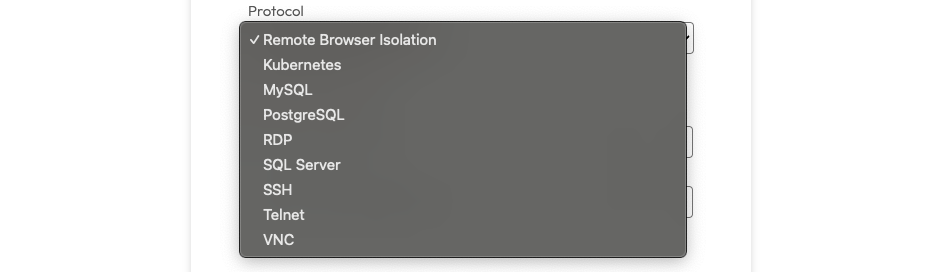
When using one of the supported databases, administrators can define new connections using Guacamole's web interface, selecting the protocol to be used for that connection from a dropdown menu labeled "Protocol":
Protocol Selection
If defining a connection through a mechanism which does not leverage one of the supported databases, such as via `/etc/guacamole/user-mapping.xml`,[ LDAP schema modifications](/keeper-connection-manager/authentication/authenticating-users-with-ldap/storing-connection-data-within-ldap.md), or[ encrypted JSON](/keeper-connection-manager/using-keeper-connection-manager/dynamic-connections.md), the protocol will must be specified using the unique, internal name for that protocol:
| Protocol | Internal name |
| ---------------------------------------------------------------------------------------------- | ------------- |
| [HTTP/HTTPS](/keeper-connection-manager/supported-protocols/remote-browser-isolation.md) | `http` |
| [VNC](/keeper-connection-manager/supported-protocols/vnc.md) | `vnc` |
| [RDP](/keeper-connection-manager/supported-protocols/rdp.md) | `rdp` |
| [SSH](/keeper-connection-manager/supported-protocols/ssh.md) | `ssh` |
| [Telnet](/keeper-connection-manager/supported-protocols/telnet.md) | `telnet` |
| [Kubernetes](/keeper-connection-manager/supported-protocols/kubernetes.md) | `kubernetes` |
| [MySQL](/keeper-connection-manager/supported-protocols/mysql.md) | `mysql` |
| [PostgreSQL](/keeper-connection-manager/supported-protocols/postgresql.md) | `postgresql` |
| [Microsoft SQL Server](/keeper-connection-manager/supported-protocols/microsoft-sql-server.md) | `sql-server` |
---
# Agent Instructions
This documentation is published with GitBook. GitBook is the documentation platform designed so that both humans and AI agents can read, navigate, and reason over technical content effectively. Learn more at gitbook.com.
## Querying This Documentation
If you need additional information that is not directly available in this page, you can query the documentation by asking a question.
Perform an HTTP GET request on the following URL with the `ask` and `goal` query parameters:
```
GET https://docs.keeper.io/keeper-connection-manager/supported-protocols.md?ask=&goal=
```
`ask` is the immediate question: it should be specific, self-contained, and written in natural language.
`goal` is what the user is ultimately trying to achieve, the reason they need the answer. Sharing it helps GitBook give you a better, more relevant answer. A goal is most helpful when it describes the outcome the user wants rather than restating the question. For example, with `ask=how do I create an API token`, a goal like `automate deployments from our CI pipeline` lets GitBook tailor the answer to that use case.
The response will contain a direct answer to the question and relevant excerpts and sources from the documentation.
Use this mechanism when the answer is not explicitly present in the current page, you need clarification or additional context, or you want to retrieve related documentation sections.